

- This event has passed.
Session #3 Book Club (Ch. 6-7)
P.S. I Still Love You — Session 3
Today we will use Chapters 6–7 to practice useful vocabulary and real-life communication: supporting someone, questioning conclusions, and matching our language to how certain we really are.
Meeting Details
Date: Thursday, September 17, 2026
Time: 10:00 a.m.–12:00 p.m. Texas time
Reading: Chapters 6–7
Location: Meeting Room #2
9:15–10:45: 765133
10:45–12:45: 188281
Session Materials
Use the reading guide and comprehension-support videos before or after the meeting as needed.
Joining on Zoom
Book Club meets in person each Thursday. If you are unable to attend in person, you may join the meeting on Zoom using the link below.
Join Book Club on ZoomBook Club Meeting Sections
Part A · Chapter Summary60-Second SummaryAbout 8 minutes
Instructions
- Work together to make a 3–4 sentence summary of the most important events in Chapters 6 and 7.
- Do not retell every detail. Choose the events that you feel are most important.
At first, … Then, … After that, … By the end of the chapter(s), …
Part B · Vocabulary RetrievalWhat Would You Say?About 15 minutes
Model example
Example only: “You are angry about something your friend said, but you decide not to answer until you calm down.”
Best expression: bite your tongue. It fits because you deliberately stop yourself from saying what you want to say. A natural sentence would be: “I had to bite my tongue until I cooled off.”
Instructions
- Read the scenario below and choose the one best expression from the phrase bank.
- Explain why it fits, and use it in a new sentence.
Choose one or two situations for the whole class, depending on time.
Situation 1
A coworker learns that a project she spent months on has been canceled. She goes quiet and says, “I need a minute.” Which expression describes the effect the news had on her?
Use it: Say one sentence that describes what happened.
Check your answer
Something shocks or upsets a person so strongly that for a moment the person does not know how to react.

Situation 2
After a stressful phone call, you need to make an important decision, but your thoughts are all over the place. Which expression describes what you cannot do yet?
Use it: What might you tell someone who wants an answer immediately?
Check your answer
To think clearly enough to make sensible decisions.

Situation 3
Your family is discussing whether to repair an expensive car. Someone keeps arguing about who forgot to fill the gas tank last week. Which expression describes that side issue?
Use it: Use the expression in a polite sentence that redirects the discussion.
Check your answer
Not relevant to the main issue being discussed.
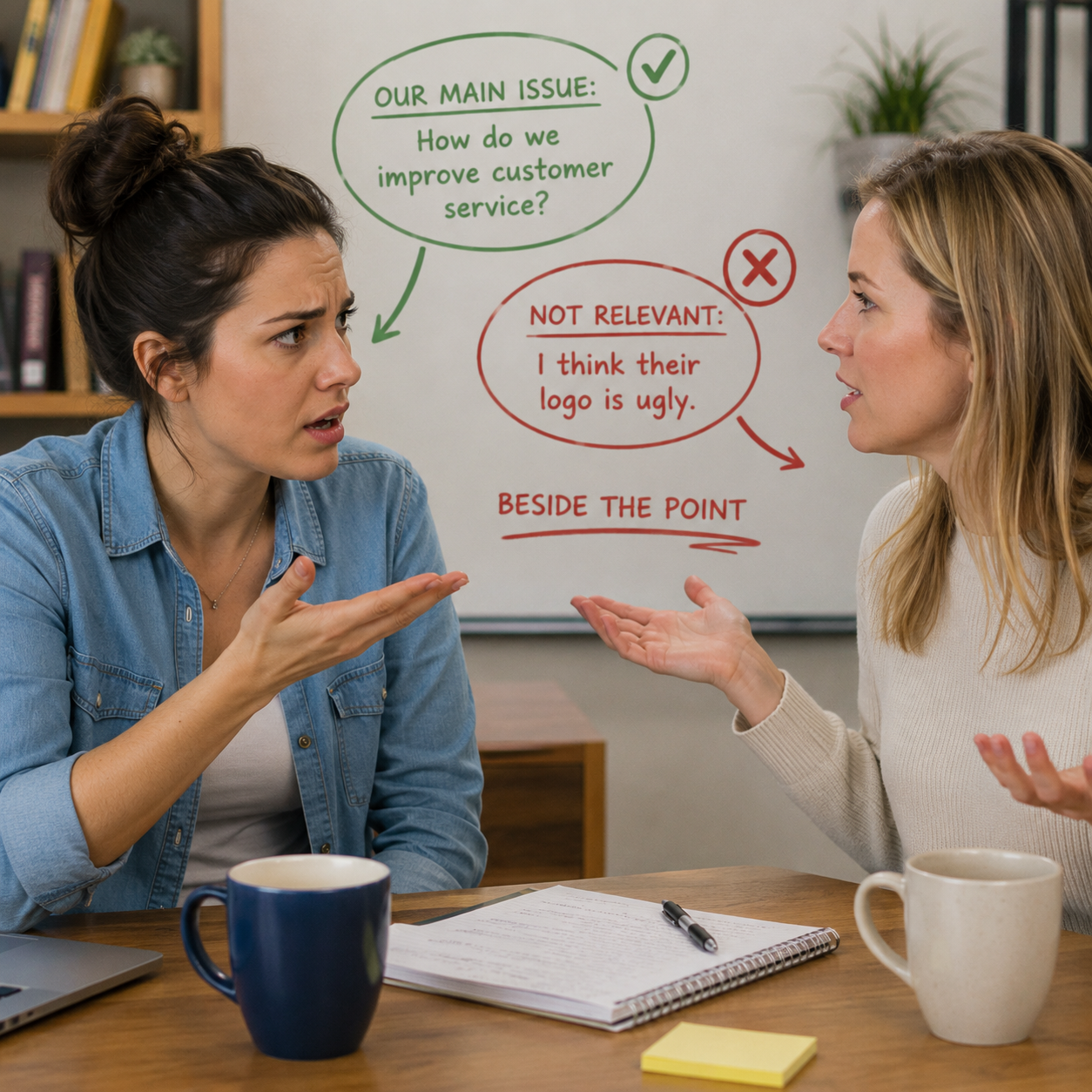
Situation 4
A supervisor tells an employee, “This report is confusing, incomplete, and not ready to send.” Which expression describes the supervisor’s very direct way of speaking?
Use it: Use the expression to describe someone who communicates this way.
Check your answer
To say exactly what you mean, even when it may sound unpleasant or very direct.

Situation 5
Your brother keeps mentioning the same embarrassing story because he knows it annoys you and enjoys watching your reaction. Which expression describes what he is trying to do?
Use it: Give one piece of advice to the person being teased.
Check your answer
To deliberately provoke an emotional reaction, especially annoyance or embarrassment.

Situation 6
A friend has had a difficult week with several problems at once. You want to ask how she is coping without asking for private details. Which expression could you use in your question?
Use it: Give a natural follow-up if she answers, “Not great.”
Check your answer
To cope or manage emotionally during a difficult situation. A common question is: “How are you holding up?”

Situation 7
You start looking through old family photos for just a few minutes. An hour later, you are still sorting, reading notes, and telling stories. Which expression explains what happened?
Use it: Give a new example involving a different activity.
Check your answer
To become very involved in something, often more than you intended.

Situation 8
You have spent most of the afternoon avoiding a task, but the deadline is tomorrow morning. Which expression describes what you need to do now?
Use it: Say something you might tell yourself or a friend.
Check your answer
To begin working seriously and with determination.

Situation 9
You are halfway to the airport when you suddenly realize your passport is still on the kitchen counter. Which expression describes that moment of realization?
Use it: Complete: “It suddenly dawned on me that…”
Check your answer
To suddenly become clear or be understood.

Situation 10
You are nervous before an important event, but you smile and act confident because you do not want your family to worry. Which expression describes what you are doing?
Use it: Say when this might be helpful—and when it might make things harder.
Check your answer
To try to appear calm or confident even though you are worried or upset.

Situation 11
Money is missing from an account, and several explanations are possible. The bank reviews records and interviews people until it understands what really happened. Which expression describes what the bank is trying to do?
Use it: Name another everyday problem that might be worth investigating this way.
Check your answer
To investigate until you discover the truth or real cause.

Situation 12
Several people criticize your friend’s decision. You do not necessarily agree with every part of the decision, but you make sure she is not facing the situation alone. Which expression describes what you are doing?
Use it: Can you do this without agreeing with everything someone says? Explain.
Check your answer
To support and protect someone when that person is facing difficulty or criticism.

Part C · Mini-ConversationsFrom the Book to Real ConversationAbout 12 minutes
Book connection
These expressions are part of the action in Chapters 6–7: Lara Jean cannot think straight after the video appears; Lucas does not mince words; Lara Jean refuses to let Genevieve get a rise out of her; Ms. Davenport asks how she is holding up; Mrs. Duvall tells her to buckle down; Lara Jean later puts on a brave face; Peter says he will get to the bottom of what happened; and Margot says Peter should have Lara Jean’s back. Now use the same language in your own conversation.
Model mini-conversation
A: “When do you have trouble thinking straight?”
B: “Usually when I’m rushing and several people need something from me at once.”
A: “Me too. What helps you?”
B: “I stop for a minute and write down what I need to do first.”
Instructions
- Discuss the assigned prompt with your partner or small group.
- Respond to what the other person says by asking at least one follow-up question.
Choose one prompt for the whole class. If time allows, choose another.
Prompt 1 · think straight
What situations make it hard to think straight? What helps you clear your head?
Prompt 2 · get caught up in something
What activities make people lose track of time? Is getting caught up in something always negative?
Prompt 3 · buckle down
What usually makes people finally buckle down? What helps with procrastination?
Prompt 4 · dawn on someone
Why can something obvious take a long time to dawn on us? Can another person help it happen?
Prompt 5 · put on a brave face
When do people put on a brave face? When is that useful, and when can it make things harder?
Prompt 6 · hold up
What kind of answer are we inviting when we ask, “How are you holding up?” What could you say if the person answers, “Not well”?
Prompt 7 · have someone’s back
What does having someone’s back look like in real life? Does it always mean agreeing?
Prompt 8 · get to the bottom of something
What kinds of everyday problems are worth getting to the bottom of? When is it better to let a small mystery go?
Prompt 9 · get a rise out of someone
Why do some people enjoy getting a rise out of others? What response usually works best?
Prompt 10 · not mince words
When is it helpful not to mince words? When can very direct language create problems?
Prompt 11 · beside the point
Why do conversations sometimes get stuck on things that are beside the point? How can you politely return to the main issue?
Prompt 12 · knock the wind out of someone
What kinds of news can knock the wind out of someone? Can the expression describe positive news as well as bad news?
Stand up, stretch your legs, and be ready to restart in 5 minutes.
Part D · Grammar in ConversationHow Sure Are You?About 20 minutes
Grammar reference: saying it more gently—and more accurately
English speakers often adjust the strength of what they say when giving advice, disagreeing, making an accusation, or responding to someone who is upset. The goal is to choose language that matches what you know, the relationship, and the situation.
Advice: should / could / might want to
- should = clear advice: “You should talk to her.”
- could = one possible option: “You could talk to her.”
- might want to = more tentative: “You might want to talk to her.”
Certainty: match the evidence
- She did it. — presented as fact
- I think she did it. — a conclusion/opinion
- She probably did it. — likely, not certain
- She might have done it. — one possibility
Soften disagreement
- “I’m not sure I agree.”
- “I don’t think we know that yet.”
- “Maybe, but…”
- “I can see why you think that, but…”
Use would for softened advice
- “Don’t accuse her yet.” → “I wouldn’t accuse her yet.”
- “Wait until you know more.” → “I’d wait until I knew more.”
Model example
Too certain: “She ignored your message because she’s angry.”
Better match to the evidence: “She might have ignored your message because she’s angry.”
The second sentence keeps the same basic idea but presents it as a possibility rather than a fact.
Genevieve did it.
I think Genevieve did it.
Genevieve probably did it.
Genevieve might have done it.
Stage 1 · Chris accuses Genevieve
Chris says Genevieve is responsible because Lara Jean is with Peter and reminds Lara Jean of the cruel rumor Genevieve once spread about Jamila Singh. Lara Jean is not convinced and says it could have been anybody who happened to see them that night.
Question: At this point, which level of certainty fits the evidence best?
Answer
Stage 2 · Lara Jean hears Genevieve joking
In French class, Lara Jean hears Genevieve joking with Emily about the video. Lara Jean is humiliated and begins to suspect Genevieve more strongly.
Question: Has the evidence become stronger, or has Lara Jean’s suspicion become stronger? Are those the same thing?
Answer
Stage 3 · The bathroom confrontation
Genevieve directly denies sending the video. Lara Jean notices the movement at the corner of Genevieve’s mouth that she believes is Genevieve’s “tell” when she lies. Lara Jean becomes certain Genevieve did it.
Question: How could Lara Jean state her conclusion accurately without presenting it as proven fact?
Answer
Stage 4 · Peter asks for the exact words
Lara Jean tells Peter that Genevieve admitted it. Peter asks whether Genevieve actually said that. Lara Jean realizes she never directly admitted sending the video.
Question: What changes when Lara Jean separates what she believes from what Genevieve actually said?
Answer
Model the final challenge
Claim: “He left me out on purpose.”
Revision: “I think he may have left me out on purpose, but I don’t know that yet.”
Choose one claim for the final grammar challenge.
Claim 1
Original: Genevieve sent the video.
Revise it so the language matches the evidence.
Possible revision
Claim 2
Original: Peter doesn’t believe Lara Jean.
Revise it so the language matches the evidence.
Possible revision
Claim 3
Original: Genevieve is jealous of Lara Jean.
Revise it so the language matches the evidence.
Possible revision
Claim 4
Original: Peter is defending Genevieve.
Revise it so the language matches the evidence.
Possible revision
Part E · Discussion CirclesBook → Life → PracticeAbout 25 minutes
Instructions
- Begin with the example from the book.
- Discuss the larger communication question.
- Do the short real-life speaking task.
- Respond to a classmate before adding your own idea.
- Use softening and uncertainty only when they fit what you really mean.
Model response
Friend: “My manager didn’t invite me to the meeting. She clearly doesn’t value my work.”
Response: “I can see why that would bother you. I’m not sure we know why you weren’t invited, though. There might be another explanation. You could ask what the meeting was about.”
Choose one discussion circle. If time allows, choose another.
Circle 1 · What does support sound like?
Discuss
When someone is upset, what makes a response genuinely supportive? Can a truthful or positive comment still miss what the person needs?
Put It Into Practice
Your friend says: “Everyone at the meeting ignored my idea. They obviously don’t respect me.”
Support the person emotionally without pretending you know why the group reacted that way.
Circle 2 · Disagree without dismissing
Discuss
What is the difference between questioning someone’s conclusion and dismissing the person’s feelings? Can a careful question be a form of support?
Put It Into Practice
Someone says: “My sister didn’t answer my text all day. She’s angry with me.”
Respond with acknowledgment + uncertainty + another possibility.
Circle 3 · Give advice without taking over
Discuss
When is strong advice helpful? When is it better to offer an option and let the person decide?
Put It Into Practice
Your friend says: “I’m sure she did it. I’m going to confront her right now.”
Try three strengths: “You should…” / “You could…” / “You might want to…” Then decide which you would actually use.
Part F · Real-Life CommunicationSupport Without Automatically AgreeingAbout 10 minutes OPTIONAL IF TIME
In real conversations, we often need to support a person and avoid claiming more than we actually know. These four moves can help. They are choices, not a script.
Model conversation
A: “My coworker didn’t reply to my message. She must be annoyed with me.”
B: “I can see why you’d wonder. I’m not sure we know that yet—she might just be busy.”
A: “Maybe. What would you do?”
B: “I’d give it a little time and then follow up.”
Instructions
- Partner A reads the statement as if it were a real conversation.
- Partner B responds naturally; use only the moves that fit.
- Continue for at least three turns, then switch roles if time allows.
Choose one scenario for the class if you use this optional section.
Scenario 1
“My friend didn’t invite me to dinner. She must be angry with me.”
Scenario 2
“My boss hasn’t answered my email. I think something is wrong.”
Scenario 3
“My package disappeared. I’m sure the neighbor took it.”
Scenario 4
“My daughter didn’t call me back. She’s obviously upset.”
Scenario 5
“Two people stopped talking when I walked into the room. They were talking about me.”
Scenario 6
“My coworker corrected me during the meeting. She was trying to embarrass me.”
Part G · Team Vocabulary FinaleDescribe It—Don’t Say It!About 8 minutes
Only the person giving clues should look at the expression.
Instructions
- Open only your assigned card.
- Describe a situation that communicates the meaning.
- Do not say the target expression or the forbidden words.
- Your team guesses the expression.
- After the team guesses, another person must use the expression in a new sentence.
Model clue
Example expression: hold a grudge
Possible clue: “Two friends argued years ago. One person forgave and moved on, but the other person is still angry every time the old problem comes up.”
The clue explains the meaning through a situation instead of simply giving a synonym.
Choose challenge cards as time allows.
Card 1 · Reveal only if assigned
buckle down
Do not say: buckle, down, serious, work
Need help?
Meaning: start working seriously and with determination
Example: I need to buckle down and finish this report tonight.
Card 2 · Reveal only if assigned
get caught up in something
Do not say: caught, involved, activity, time
Need help?
Meaning: become very involved in something, often more than you intended
Example: We got caught up in talking and lost track of time.
Card 3 · Reveal only if assigned
have someone’s back
Do not say: back, support, protect, defend
Need help?
Meaning: support or protect someone during difficulty or criticism
Example: I knew she had my back during the meeting.
Card 4 · Reveal only if assigned
put on a brave face
Do not say: brave, face, pretend, worried
Need help?
Meaning: look calm or confident even though you are worried or upset
Example: He put on a brave face before the interview.
Card 5 · Reveal only if assigned
get a rise out of someone
Do not say: rise, reaction, tease, annoy
Need help?
Meaning: deliberately provoke an emotional reaction
Example: Ignore him—he’s just trying to get a rise out of you.
Card 6 · Reveal only if assigned
think straight
Do not say: think, straight, clear, confused
Need help?
Meaning: think clearly enough to make sensible decisions
Example: I was so tired that I couldn’t think straight.
Card 7 · Reveal only if assigned
beside the point
Do not say: beside, point, relevant, issue
Need help?
Meaning: not relevant to the main issue
Example: Who arrived first is beside the point.
Card 8 · Reveal only if assigned
not mince words
Do not say: mince, words, direct, honest
Need help?
Meaning: say exactly what you mean, even if it sounds very direct
Example: She didn’t mince words about the problem.
Card 9 · Reveal only if assigned
hold up
Do not say: hold, up, coping, difficult
Need help?
Meaning: cope or manage during a difficult situation
Example: How are you holding up after such a stressful week?
Card 10 · Reveal only if assigned
dawn on someone
Do not say: dawn, realize, suddenly, understand
Need help?
Meaning: suddenly become clear or understood
Example: It dawned on me that I had left my keys at work.
Card 11 · Reveal only if assigned
get to the bottom of something
Do not say: bottom, investigate, truth, cause
Need help?
Meaning: investigate until you discover the truth or real cause
Example: We need to get to the bottom of why the bill is so high.
Card 12 · Reveal only if assigned
knock the wind out of someone
Do not say: wind, breath, shock, surprise
Need help?
Meaning: shock or upset someone so strongly that they cannot react normally for a moment
Example: The unexpected news really knocked the wind out of her.
Part H · Exit RetrievalOne Expression I Want to KeepFinal 3 minutes
Model exit response
Expression: buckle down
Meaning: start working seriously and with determination
New example: “I’ve been putting off the paperwork all week, so I need to buckle down tonight.”
Before you leave, choose one expression from today that you think you could actually use in English.
Tell a partner:
- What is the expression?
- What does it mean?
- Give one new example.
Tomorrow: Can you still remember your expression without looking at the vocabulary list?
Homework · Group ChatSay It With the Right Amount of CertaintySend it before next Book Club
Instructions
- Think of one everyday situation where you are not 100% sure what happened.
- Text the Book Club group chat one sentence using I think…, probably…, or might… so your language matches how certain you are.
Example
“My neighbor’s car isn’t there, so I think she might be out of town.”